Standing 130+ years away from the largest wave of Luxembourg immigration into Chicago and the United States, it is easy to repeat the often repeated oral tradition that our ancestors came from Luxembourg in the 1880s and 1890s and started as day laborers and truck farmers who then built greenhouses to grow year-round.
What this leaves out is how did they do this? What social and financial networks did they rely on when arriving? What are the familial relationships underpinning this group of immigrants? What means did they come with? How did they become successful? Questions abound.
My next several posts will be focusing on the five original “men in the middle” of the Vegetable Growers Supply Co., centered in Rogers Park,. IL: J.P. Smith, Joseph Rengel, J.B. Molitor, Michael Leider, and Robert F. Dilger. Each of these men, were in their primes at the founding. (John Phillip) J.P. Smith was 53 years old at the founding of the new company, being born in 1865. (John) Joseph Rengel was 47, born 1871. (John Bernard) J. B. Molitor was 51, born in 1867. Robert F. Dilger was 59, born in 1859. The young man in the group, Michael Leider, was 42, born in 1876.
And all but Michael Leider were not immigrants. They were born in the U.S. J. P. Smith, Joseph Rengel, and Robert F. Dilger were born in Chicago, Cook County, IL and J. B. Molitor was born in Sheboygan, WI. Only Michael Leider was born in Luxembourg (Deikirch). This point is critical, as these men and their families had already established a presence and an economic presence four decades before the bigger group of immigrants arrives and six decades before the founding of the new company. The earlier immigrants greatly helped those who followed.
The new company’s president, J. P. Smith was the son of a German immigrant, Peter Schmidt Jr., born in 1824 in the Rhineland Palatinate region immediately east of Luxembourg and west of Frankfort Germany, who came to the U.S. in 1840 at age 16, with his father, Peter Schmidt Sr., 52 at the time, and settled north of the city of Chicago. The 1850 census rolls for Ridgeville (now part of Evanston) and in the 1870 Evanston census. Peter Schmit Sr. (his German name, spelled incorrectly by an immigration clerk as Schmidt), is recorded as entering the U.S. with $6,000 French francs, today worth about $375,000 today, indicated he had financial means in Germany before coming to the U.S.
Peter Schmidt Sr. came over with another German immigrant, Henry Fortmann, and they built log cabins in what’s is now part of Evanston, and started truck farming to serve the growing city. Eventually, their combined lands encompassed 250 acres. In 1851, Henry Fortmann built a small frame house near Devon and Touhy Avenues to offer mass for Luxembourger and German immigrants. In 1852 it was dedicated as the first and later to become, the well-known St. Henry Church.
Peter Sr. went on to become a prominent Ridgeville leader, serving as justice of the peace and was a master bricklayer who recycled bricks from the Chicago Fire to build his dream home at 6836. N. Ridge Boulevard.
His son, Peter Schmidt Jr. married Elizabeth Phillips, also born in Germany (Koblenz), in 1849 in Cook County, IL. Her father, Jacob Phillip emigrated in 1842 and went on to own several tracts of land at Ridge and Touhy as well as a flour and feed store in Ridgeville. Her brother, Jacob’s son, founded Phillips State Bank at 7001 N. Clark Street in 1895. It is this bank that shows up in the articles of incorporation of the Vegetable Growers Supply Co. Peter Schmidt Jr. had a twin brother, Jacob, who emigrated with the family in 1840 but at some point left Chicago, probably after the Great Fire, and who died tragically after an accidental gunshot wound in 1882 in Aspen Colorado.
Peter Schmidt Jr.’s son, our J. P. Smith, married Katherina Evert, born in Rose Hill, Chicago in 1869. Her parents were both Luxembourg (Deikirch) immigrants who arrived around 1851. The1900 census records have J.P. Smith as a farmer and in 1910 as a greenhouse grower, which means this family made the transition to growing under glass, like all the others.

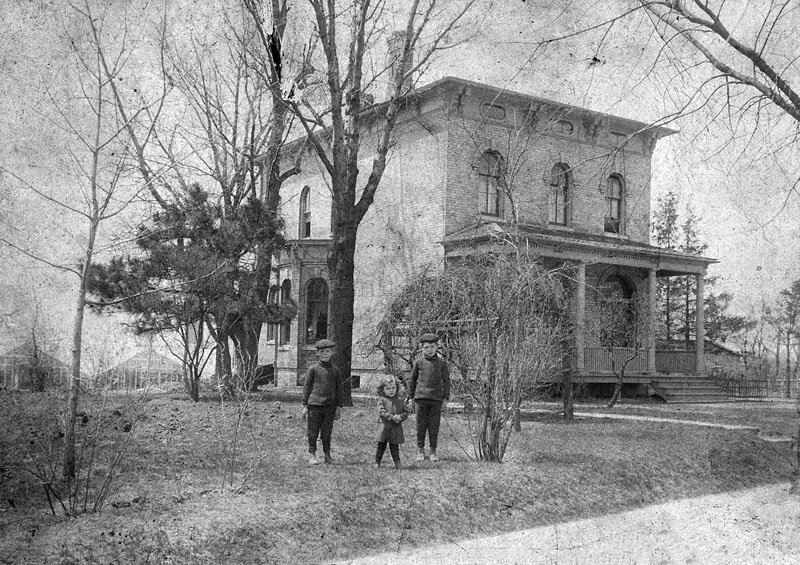
“Peter Jr. is in the process of building the new Victorian brick house just a few hundred yards north at 6836 Ridge. (still standing today and still in the family) The mason’s have just dug the 100 ft long trench (3ft wide and 2ft deep) so the wagons can dump the lime for mortar-making that will take a year to work before construction begins. The carpenter has quoted and will build for $106.00 (about 6 months work.) The Georgian marble for the fireplace was ordered a year ago but the Civil War has eliminated that source in Georgia and so Michigan veined-white marble will be used instead to create the Paris apartment style fireplace in the front parlor. The 2 Eisenglass stoves, for heating the upstairs and downstairs, will come later. Heating stones on them to place at the foot of your feather-bed will help with the winter nightly cold. … Peter Jr’s sons in later years would climb the big poplar tree in the back of the 1871 – 6836 N Ridge – house to enter their 2nd story bedrooms; thus avoiding their awaiting Father states Louisa Smith, his daughter.” – from davidafortmanancestors.com
J. P. Smith shows up in probate records as the executor of his mother-in-law’s will in 1917 and as an administrator of his father’s estate in 1902, who died without a will. The amount of his father’s estate in probate was approximately $26,000 (approximately $806,000 today), no small sum even for a well-off German immigrant farmer making his way in a part of Illinois just less than a decade after the Blackhawk tribe is cleared from the area. Around the turn of the century, J. P. Smith was the Commissioner of Indian Boundary Park (I remember walking there as a boy when we visited my great-grandfather’s house and greenhouse). J. P. Smith was also quite experienced in greenhouse trade associations. In June of 1913, five years before the new company is formed, J. P. Smith was named a director of the Chicago Greenhouse Vegetable Growers’ Association (along with Robert F. Dilger and J. B. Molitor) and at this meeting, the directors discuss the escalating price of small lettuce boxes.
The Schmidt family was an important, well-off early settler of Ridgeville, associated with the founding of St. Henry Church in Rogers Park and was familiar with farming, woodwork, construction, business and banking. J. P. Smith grows up in this family of strong means and capabilities precisely at the time Chicago is rapidly growing, allowing truck farming and greenhouses to open up many paths to success for new immigrants. America’s cheap access to land and no form of feudalistic practices with its onerous taxation to land barons gave Luxembourg and German immigrants much better economic prospects.
J. P. Smith was well prepared, well-connected, and perhaps, as far as I can surmise, the leading man among all the growers in the region. With his wife’s Luxembourg background, further connections with many Luxembourg immigrants in the 1880s and 1890s became possible. It would be natural, or perhaps inevitable that J. P. Smith would lead this company.
At the helm of the Vegetable Growers Supply Co. at its start was not a Luxembourg immigrant, but a son of well-off German immigrant family with the needed knowledge, skill and economic capability to lead the others. As I dig into the background of the other four leaders in future posts, it will become clearer that the flourishing of Luxembourg greenhouses in the north Chicago area was made possible by a combination of relationships, skills and business savvy of early German and Luxembourg immigrants who settled and became the founding families of these areas beginning in the 1840s. As it turns out, many things are connected.
As I continue to delve into the details of the new company, its founders and the connections between them, it is very likely that I may miss things, make incorrect inferences, start with faulty assumptions and otherwise make errors. For anyone with corrections, oral histories or stories to tell, please do so!
 Chicago Greenhouse Growers
Leave a comment