
-
From whom to buy lumber? Where to rent space?
Several of the directors behind the startup of the Vegetable Growers Supply Co. were already engaged in directing farmers’ associations. In the 1913, J. P. Wagoner, J. P. Molitor, Frederick Weber, J. P. Smith, Chas Hengesch, Robert F. Dilger, Peter Schumer, Micheal Leider, John Becker, Nicholas Platz, and Paul Nazig were elected the directors of the Chicago Greenhouse Vegetable Growers Association. The names highlighted here are also original stockholders in the new supply company.
The greenhouse growing business had no shortage of industry associations and industry publications. In addition to vegetable growing associations, associations for carnation growing appeared in major cities in the United States as well as a national association for carnations. Similar associations existed for chrysanthemum growers. The Florists Review and the American Florist were two publications out of Chicago (both on South Dearborn Street) and had great readership by Chicago greenhouse growers. The Market Growers Journal, out of Louisville Kentucky was focused on commercial vegetable growing nation-wide. Chicago became a great location for some of these industry publications because it had already established itself as printing and publication center. Lumber shipped from the north by rail makes large-scale printing possible. Between the industry associations and the industry publications, greenhouse growers and agriculture in general have a long history of best practice and information sharing.
With the consolidation of all forms of production into fewer and larger companies, there is less of a need to widely share (and profit from the sharing via publications) information and practices. In this regard, turn of the 20th century greenhouse growers were more avid communicators, perhaps, than most today. And as I have found out in my own family’s genealogy and immigration patterns, these associations formed the basis of a community, where extended family members and fellow immigrants can meet, conduct business and socialize.
At the time of the founding of this new supply company, a couple of critical market issues were fermenting. The first is that those greenhouse growers who transitioned to flower crops made more money. As early as the 1880s or sooner, greenhouses were not just producing vegetables, but flower crops. In the coming decade ahead, vegetable growing under glass shifts entirely to new and more profitable flowers such as carnations and chrysanthemums. Moreover, the need to control the escalating costs of doing business are eternal. At the June 1, 1913 Chicago Greenhouse Vegetable Growers Association directors, the directors were concerned that the size of the boxes used to transport lettuce was too small and hence too expensive. The issue of box size and cost was placed as an item to be addressed in the next year. Well before the forming of this new supply company, boxes to ship produce were a problem.
At the Vegetable Growers Supply Co. directors meeting on December 30, 1918, at 8 PM held at Arcanum Hall 7013 Ravenswood, Chicago, the directors awaited the report from their two committees — one on a source of lumber supply and the other on looking for space. Nic Schmidt and J. P. Molitor reported that they visited Bellinger Mills in Bellinger, WI and S. Gruzenski, the owner of the mill. They also met with Mr. Stryks, the owner of Stryks Mill in in Sublin WI and J. H. Hill Box Co.. All three suppliers (of course) expressed eagerness to supply the new company with lumber.
The committee on space reported that they saw several locations for buying or renting and recommended renting from Wm. Becker’s shop space on N. Clark Street for $40 ($640) a month as they felt this was the “best and cheapest” place to locate. After a long discussion, the directors approved the recommendation and gave the committee the power to rent the space and purchase machines and trucks from Wm. Becker as they saw fit.
The directors also approved expenses of $70.13 ($1,122) for rail fare and the hotel room for six days, and of course the $6 per day pay for their efforts, $72 ($1,152). Additional expenses of $40.05 ($642) for hall rent, postage stamps, printing and envelopes were approved.
The directors also approved a motion to begin looking for a “good manager” for the company and what he salary he would need.
Over the next few months, the new company will continue to deal with machinery costs, labor costs and space costs.

South Water Street Market, Chicago, IL around 1918. This is what all the stockholders of the Vegetable Growers Supply Co would have seen each trip to the market. You will notice the mix of horses and combustion engine trucks and of course, boxes everywhere. The congestion would continue to become a problem and eventually the market would be relocated in 1925, just a few years after the founding of the new supply company, to 16th and Racine, Chicago’s near south side (see: https://en.wikipedia.org/wiki/South_Water_Market). All dollars are followed with 2021 adjusted dollars in parentheses
-
Off to Wisconsin!
The Vegetable Growers Supply Co held a directors meeting on December 16, 1918 at the Odd Fellows Hall, 7001 N. Clark Street, Chicago, but starting late at 9:00 PM after President J. P. Smith called the the group to order. The board appointed two board members to make a trip to Wisconsin to “see the mill owners” and find out of the company could procure box lumber and at what prices. Nic Schmidt and J. P. Molitor were appointed and provided with $3 per day ($55 in 2021 dollars) plus traveling expenses.
In anticipation of upcoming contracts to get the business started, the directors voted to direct the treasurer to get a surety bond for $10,000 ($183,000 in 2021 dollars). Also, the board directed to pay legal fees to Luther W. Benson for services to date as part of incorporation.
The board also appointed a committee of three, including the president J. P. Smith to look for a place to open business. J. P. Smith selected Michael Leider and Anthony Kremer to assist him in this search.
All minutes from here on out are handwritten, as only the incorporation minutes and typed.

Minutes from the December 16, 1918 directors meeting. -
Don’t box me in
The oral tradition conveyed to me by my father was that Vegetable Growers Supply Co. was formed because the wooden box makers (produce was carried in wooden boxes to the market) were raising prices much too high for the greenhouse growers to accept. In response, they decided to form Vegetable Growers Supply Co. to make their own boxes.
The documents establishing the new company confirm this:
The object for which it is formed is, to manufacture, buy, sell, at wholesale and retail, lease, exchange, hold, own, dispose of or otherwise deal in boxes, baskets, barrels, sacks and other receptacles and containers for delivering, packing, and shipping vegetables and other farm produce;
But the company was also not limited, at least at incorporation, to just that, with the following additional objectives:
… to manufacture buy, sell, at wholesale and retail, lease, exchange, hold, own, dispose of or otherwise deal in fertilizer, agricultural implements and machinery, wagons, harness, trucks and all apparatus, appliances and supplies that are useful and convenient to the business of truck gardeners and farmers, and to buy, sell, at wholesale and retail, lease, exchange, hold, own, dispose of or otherwise deal in seed, grain, hay, coal and lumber, and to engage in and carry on any business similar interests.
The company was capitalized with stock totaling $25,000 ($400,000 in 2021 dollars), with shares at $50 each ($800) and a total of 500 shares. The corporation duration is noted at 99 years.
The officers names in the articles of incorporation include J. Philip Smith as President, Joseph Rengel as Vice President, John. B. Molitor as Secretary and Michael Leider as Treasurer.
At the first director’s meeting, held on December 6, 1918 at 76 W. S. Water Street at 3:00 PM, the directors agreed to rules about stock ownership. Stocks would be issued to each holder after fully paying the stock price and marked with the corporate seal. The corporation held first rights on purchase stock being transferred, but only after the stockholder wishing to transfer stock notifies the corporate secretary, who in turn notifies all stockholders. An additional section was added to the templates legal documents prohibiting any one stockholder from holding more than 20 shares.
Present at this first director’s meeting were Ferdinand Kutz, Joseph Rengel, John P. Leider, Michael Leider, John C. Laubach, J. Philip Smith, John Molitor, Nicholas Schmidt, Nicholas Platz and Anton Kramer. J. P. Smith acted as chair of the meeting.
With this incorporation, one can infer that these truck farmers, who raised a substantial amount of money to capitalize this company, were concerned about two things: 1) creating a new and controlled source of supply to prevent price escalation of boxes and 2) be transparent about ownership and prevent any one truck farmer from dominating the stock ownership.
For a group of immigrants in this country not more than 25 years for most of them, the access to and the mechanics of incorporation in Chicago at this time enabled them to form a collective. Farmers were well connected to the gears of capitalism.
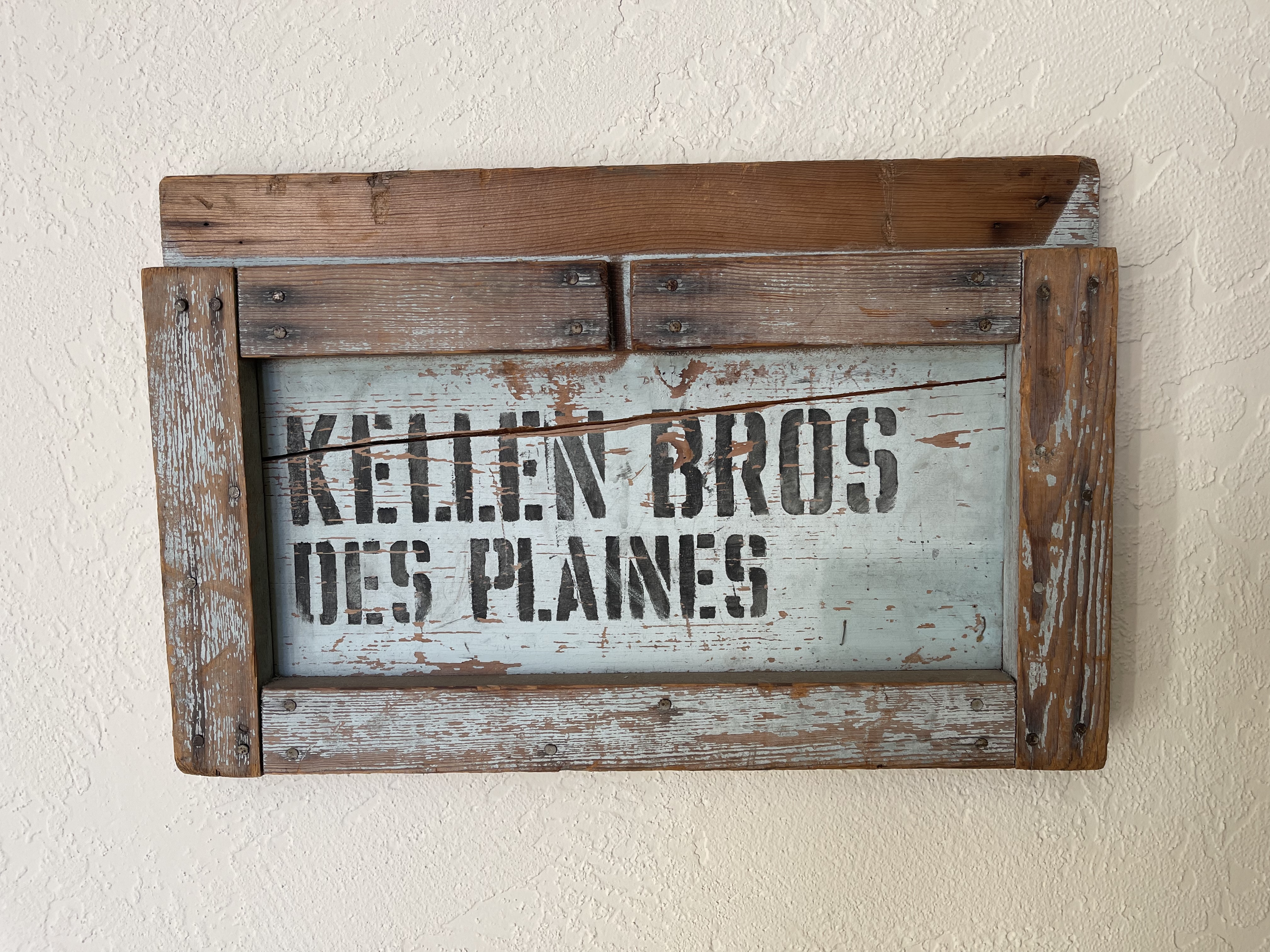
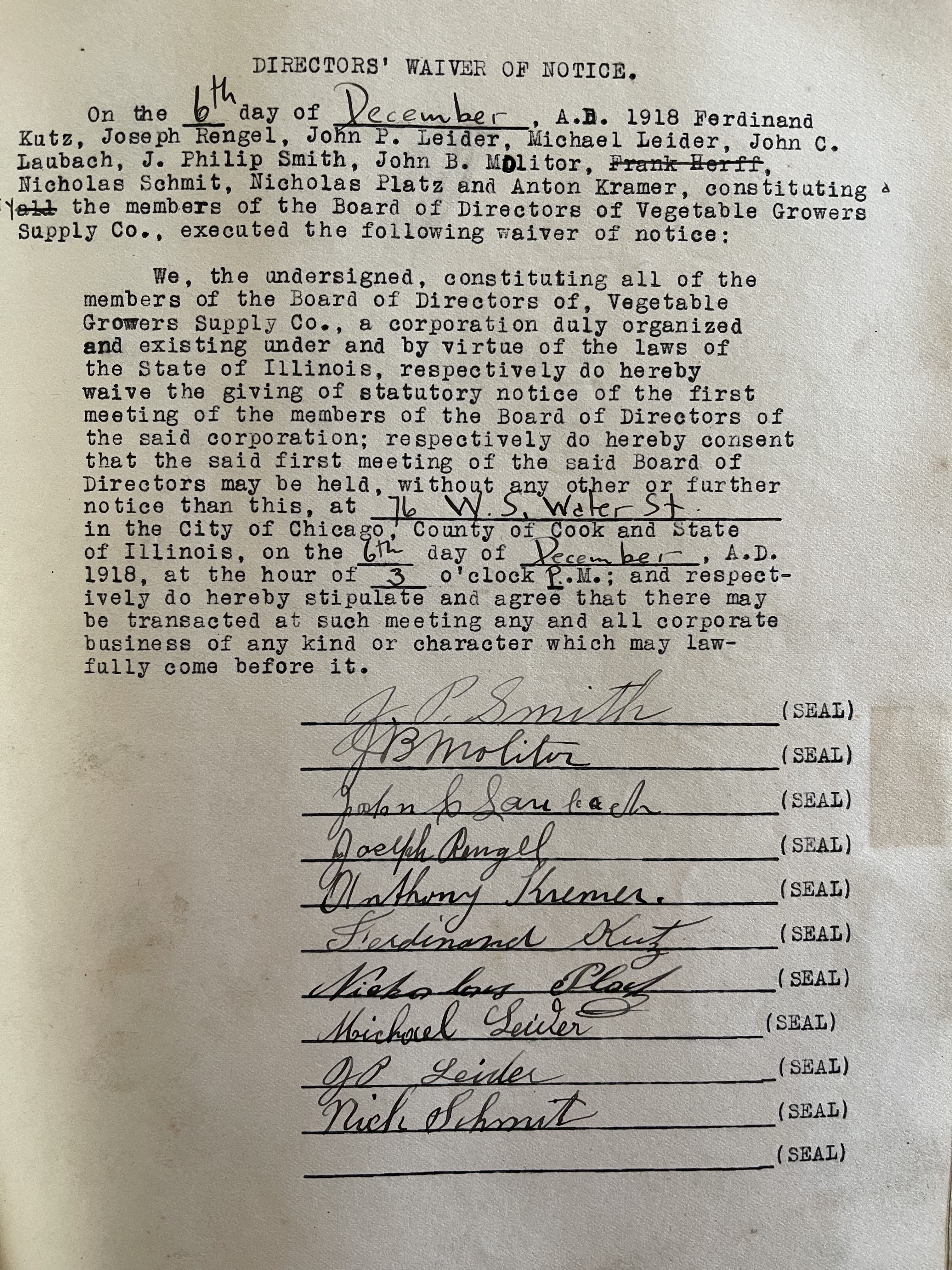
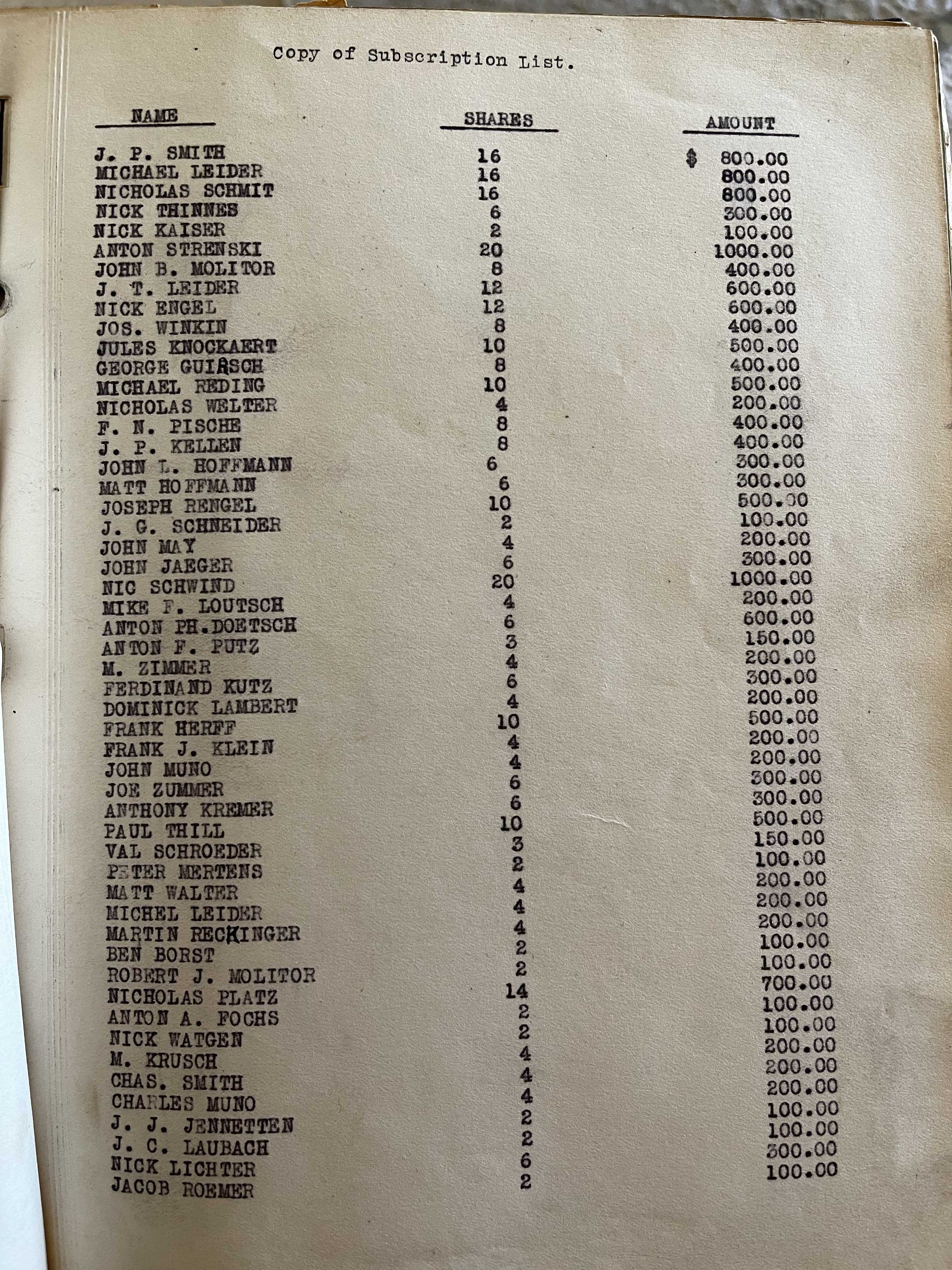
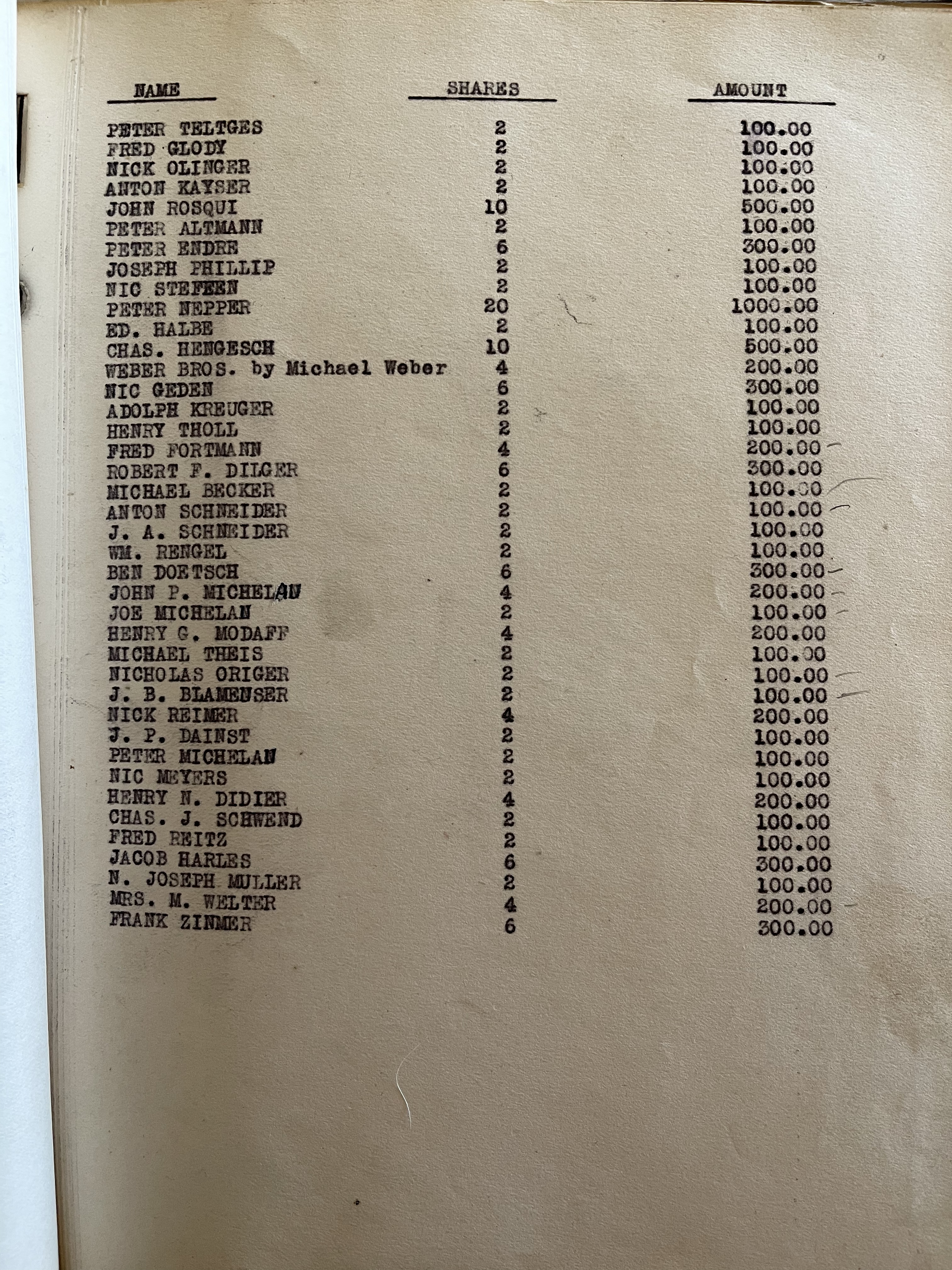
And end portion of an old wooden box used to ship produce and flowers. Also a list of stockholders and shares purchased and allocated and the signatures of the directors at the first director’s meeting. -
In the beginning…
On the 13th of November, 1918, Louis L. Emmerson, the Illinois Secretary of State, authorized the creation of the Vegetable Growers Supply Co. Corporation. A week and a day later, on November 21, 1918, the Vegetable Growers Supply Co., held their first shareholder meeting of the original subscribers of the company’s capital stock. That meeting was held at 7013 Ravenswood Avenue, Chicago, IL at 8 PM.
Those initial shareholders were as follows and in the order listed in the minutes:
- J.P. Smith
- Michael Leider
- Nicholas Schmidt
- Nick Kaiser
- Anton Streenski
- John B. Molitor
- J. P. Leider
- Nick Engel
- Jos. Winkin
- Jules Knockaert
- George Guirsch
- Michael Reding
- Nicholas Welter
- F. N. Pesche
- J. P. Kellen (my great grandfather)
- John L. Hoffmann
- Matt Hoffman
- Joseph Rengel
- John May
- John Jaeger
- Nic Schwind
- Mike L. Loutsch
- Anton Ph. Doetsch
- Anton F. Puetz
- M. Zimmer
- Ferdinand Kutz
- Dominick Lambert
- Frank Herff
- Frank J. Klein
- John Muno
- Joe Zimmer
- Anthony Kremer
- Paul Thill
- Val Schroeder
- Peter Mertens
- Math. Welter
- Michael Leider
- Fred Fortmann
- Robert F. Dilger
- Michael Becker
- Anton Schneider
- J. A. Schneider
- WM. Rengel
- Ben Doetsch
- John P. Michelau
- Joe Michelau
- H. G. Modaff
- M. Tjheis
- N. Origer
- J. B. Blaminser
- Mick Reimen
- J. P. Dainst
- Peter Michelau
- Ni. Meyers
- Henry N. Didier
- Chas K. Schwind
- Fred Reitz
- Jacob Harles
- N. Josoph Muller
- Mrs. M. Welter
- Frank Zimmer
- Ben Borst
- Robert J. Molitor
- Nicholas Platz
- Anton A. Fochs
- Nick Watzen
- M. Kinsch
- Chas. Smith
- Charles Muno
- J. J. Jennetten
- J. C. Laubach
- Nick Lichter
- Jacob Romer
- Peter Tiltges
- J. G. Schneider
- Fred Glody
- Nick Olinger
- Anton Kayser
- John Rasqui
- Peter Altmann
- Peter Endre
- Joseph Phillip
- Nic Steffen
- Peter Nepper
- Ed. Halbe
- Chas. Hengesch
- Michael Weber
- Nick Geiden
- Adolph Krueger
- Henry Tholl
The meeting was called to order by J. P. Smith and all were present. John B. Molitor was elected (unanimously) the secretary of the meeting. Fredinand Kutz, Joseph Rengel, John P. Leider, Michael Leider, John C. Laubach, J. Phillip Smith, John B. Molitor, Frank Herff, Nicholas Schmidt, Nicholas Platz and Anton Kramer were elected as directors for one year. The address for the company was officially recorded as 6939 N. Western Avenue, Chicago, IL. With no further business, the meeting was adjourned.
As oral history relayed to me indicated, it is entirely likely that short meetings were followed with some gaiety of some kind, most likely enhanced with some libations…
When I get the time, I will summarize each meeting of the Vegetable Growers Supply Co., and in time, time willing, follow up with the minutes of the Chicago Carnation Growers Association.
-
Chicago Greenhouse Growers
In conveying the history of the Chicago Greenhouse Growers, based on the various documents passed on to me by my grandfather, and the oral history of stories from long ago conveyed to me by my father, I hope I will serve a useful purpose, especially for others who wish to find their own family in this history and perhaps, to connect the old with the new for a good and higher purpose. Too often we assume that we are the modern ones, the ones who are better than those who came before us, because of course, we have all this technology that has advanced us far beyond them, and we have all this knowledge they did not possess, or so we like to think and say, that they were perhaps a bit rougher and cruder than people today.
Nothing could be further from the truth…

