
-
The directors increase capital stock 200%
All the minutes of the new Vegetable Growers Supply Co. were handwritten by J. B. Molitor himself. As I read these minutes more than 100 years removed from their original writing in 1918 and 1919, I have come to learn J. B.’s formulaic but in some places idiosyncratic use of language, including his very consistent misspellings of a few words and the peculiarities of his cursive letter forms. It’s a window into the past and a style of writing no longer used and the style contrasts sharply with today’s notes and minutes even more so in its handwritten form. The pen is far less forgiving and correctable than the computer and its software and thus requires more concentration.
But not all the company’s minutes are handwritten. The minutes and documents related to the initial issuance of initial stocks and in this case, the expansion of capital stock from $25,000 ($400,000) to $75,000 ($1.2 million) are typed. Lawyers are involved and the business seems more serious. The initial round of shares sold in November 1919 and since sold totaled about 494 at $50 a share or nearly all of the $25,000 initial offering. J. P. Smith needed shareholder approval to raise more capital.
So J. P Smith called the directors to order at special board meeting on February 22, 1919 at 8 pm at the company’s office at 1815 Birchwood Avenue, Chicago, IL (north of Touhy Ave and West of Clark Street in Rogers Park). All the board members were present (J. P. Smith, Joseph Rengel, P. F. Dilger, John B. Molitor, Michael Leider, Anthony Kurtz, Frank Herff, Henry Didier, Matt Hoffman, Ferdinand Kutz and Nicholas Platz).
The board proposed a motion to hold a special meeting of all the stockholders on Saturday, April 12, 1919 at 7 pm to vote on the threefold expansion of capital. This meeting will require public notification required by law. This motion and the preamble regarding the board members present are typed, as they relate to the expansion of capital. The rest of the minutes are handwritten, indicating that J. P. Smith had the necessary resolution drawn up before the special board meeting.
After proposing, but not yet approving this resolution, the board moved on to other important business: to set the prices of the boxes to be manufactured. The boxes from the first shipment of lumber were set at $45 per 1,000 boxes, or about 72 cents per box in today’s dollars. The prices for lettuce boxes nailed up was set at $57.50 per 1,000 or about 92 cents per box in today’s dollars. (I am not certain what prevailing box prices were at the time and am still researching this!)
The board then agreed to hire a bookkeeper for J. P. Smith at the cost of $18 per week ($288) and to purchase fire liability insurance for the two trucks, a one-ton truck and a two-ton truck. The liability caps are $1,300 ($20,800) and $1,700 ($27,200) respectively. The board also approved taking out workers compensation insurance for up to $100 a week in payroll ($1,600) and for the president to insure the shop, the nailing machines (more on that in a future post) and boxes against fire.
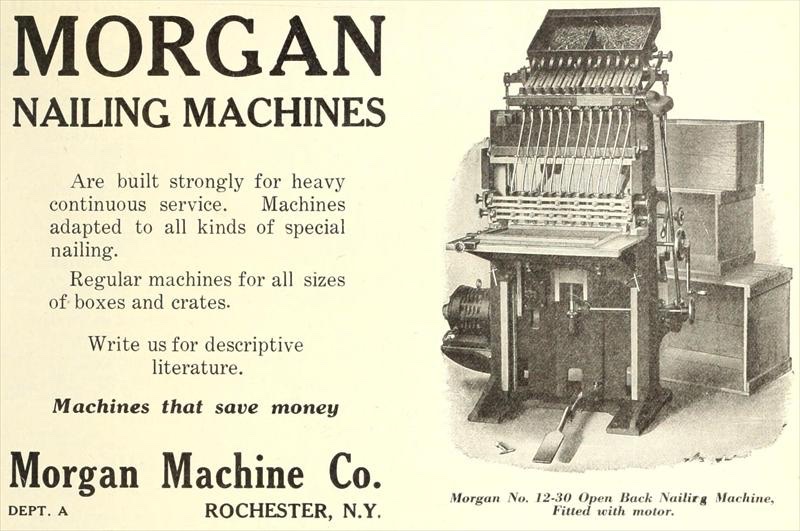
Not the exact nailing machine the Vegetable Grower’s Supply Co. used, but one from the manufacturer they did have and from the same time period. And of course the last order of business, after clearing pricing and insurance needs, was to approve the resolution for the shareholder meeting in increase capital stock. That motion was made by Robert F. Dilger, seconded by Henry Didier and passed. Interestingly enough, I can detect a sort of passing around the responsibility for making and seconding motions as nearly all the board members found their way into the minutes.
Knowing that the number two occupation for Luxembourgers in Chicago behind working in a greenhouse was most likely serving as a barkeep, the one unresolved question, unanswerable from the minutes is whether alcoholic libations (beer) was consumed before or after the meeting. The oral tradition I received was that drinking occurred generally before. However I cannot confirm that through a close examination of J. B. Molitor’s handwriting and no mention is ever made in any minutes.
Perhaps J. B. Molitor did not drink. Or he was very practiced at it.
-
Securing lumber contracts and moving with urgency…
With corporate governance for the Vegetable Growers Supply Co. tidied up just a couple weeks ago and a three-person executive committee in place (J. P. Smith, president, J. B. Molitor, secretary and Joseph Rengel, vice-president), J. P. Smith called a special meeting of the board of directors on February 5, 1919 at 8 P.M. at Arcanum Hall, 7013 Ravenswood Ave., Rogers Park, Chicago, just two weeks after the last directors meeting.
Newly elected board members for the year, J. P. Smith, J. B. Molitor, Robert F. Dilger, Michael, Leider, Anthony Kremer, Ferdinand Kutz, Nick Platz, Henry Didier, Frank Herff and Math Hoffman were present. Only Joseph Rengel was absent.
The board approved a motion to authorize the executive committee to work out the details of a contract, at the prices quoted by Mr. Hieb, the owner of one of the Wisconsin lumber mills the Vegetable Growers Supply Co., wished to use for lumber supply. The board then cancelled the upcoming regular board meeting coming up the next four days on February 9, and adjourned.
While the board meetings were carrying on the mechanics of starting up a new business in January, 1919, J. P. Smith is also working on a significant expansion of capital stock that will enable the company to raise additional money. All these legal details will be presented in just two weeks at the next board meeting and in two weeks after that at the next full shareholder meeting, March 5, 1919.
Above all else, these founders are moving quite quickly in just a couple months time to establish this company.
-
Joseph Rengel & Robert F. Dilger: Trusted allies of J. P. Smith
At the start of the new company, the Vegetable Growers Supply Co., in 1918, Joseph Rengel served as the vice-president of the company. In January, 1919, Michael Leider turned down the nomination as Treasurer and instead nominated Robert F. Dilger. Michael remained on the board as an elected director. An executive committee which was formed in January 1919 included the following three men: J. P. Smith (president), J. B. Molitor (secretary), and Robert F. Dilger (treasurer). The executive committee was a subset of the 11-member board of directors. Joseph Rengel was elected by the board to serve as Vice President.
So why were Josph Rengel and Robert F. Dilger part of this close-knit founders group?
St. Henry’s Catholic Church looms large in Chicago Luxembourg history. The first St. Henry Church was a small frame house built by recent German immigrant Henry Fortmann in 1852. Peter Schmidt, Sr. (Smith) emigrated from Germany to the Rogers Park area in 1842 with Henry Forman and between their arrival in this area in 1842 and the construction of St. Henry Catholic Church 1 in 1851, masses were held in Peter Schmidt Sr.’s log cabin house.
The second St. Henry’s Church was built in 1871 and was a larger wooden structure. It was built by Franz Paul Dilger, a German immigrant who arrived in the area in 1854 at 24 years old, coming from Wittenberg, Germany and leaving his native country for political differences, according to family stories. Franz Paul came to the U. S. with carpentry skills and, as a building contractor, had built a number of buildings in Grosse Point (present day Wilmette), Niles Center (present day Skokie) and Rogers Park. Unfortunately, Franz Paul Dilger would die relatively young in 1872 at 45 years old, and about four years after his wife died, leaving several young kids as orphans.
One of those young kids was was our Robert F. Dilger, the new treasurer for Vegetable Growers Supply Co., in 1919. He lost his mother at aged 10 and father at aged 14. While his siblings married and move on to Milwaukee, WI and Waukegan, IL, Robert F. remained in Chicago, becoming a truck farmer at the old homestead in Edgewater (6058 N. Clark St., just a bit south of Roges Park, but considered in the new company’s Rogers Park district).
In 1847, Joseph Rengel’s grandfather, Peter Joseph Rengel, emigrated from western Germany (Koblenz, about 100 miles east of Luxembourg) with his wife and kids ranging from 10 to 21 years old and settled in New Trier township (north of Evanston, the Grosse Point shareholder district) as a farmer. While some of Peter Joseph’s children stay on in the Chicago area, two move on to Minnesota. Peter Joseph’s son, John Joseph, marries a immigrant who arrived in the early 1840s from Trier, Germany (very near the eastern Luxembourg border) and is farming in New Trier township with a young family in tow, including our Joseph, who is 8 years old at the time.
Our Joseph Rengel married a daughter of Koblenz, Germany immigrants who also arrived in the area in the 1870s. By the time of the formation of the Vegetable Growers Supply Co. in 1918, he is working as a truck farmer in New Trier township. And not surprisingly, in 1900, Joseph’s father is living with his daughter, Margaret without his wife (who passed in 1891), and with his son-in-law, John Evert, and their new family in the New Trier township (Grosse Point Village). They were married in 1889.
Going back a couple posts, the Vegetable Growers Supply Co. president, J. P. Smith, in 1888 married Catherine Evert, whose Luxembourger family settled in Rose Hill in Edgewater in the 1840s. This John Evert, married to our Joseph Rengel’s sister, is the cousin of J. P.’s wife, Catherine Evert!
Getting back to the original question: Why these two men for these officer roles? Three facts stand out. First, both men were born in the the area and come from families settling at the same time as J. P. Smith’s family — in the 1850s and 1850s. These were an early wave of German and Luxembourg immigrants in the area. Second, both have family or personal relationship with J. P. Smith’s family. In the case of Robert F. Dilger, it is through his grandfather’s association with Franz Paul Dilger in the building of St. Henry’s Catholic Church 2 and most likely ongoing association with Franz’s orphaned children including our Robert F. Dilger. In the case of Joseph Rengel, J.P. Smith had a family relationship via marriages with him. Third, both were now truck farmers in and around Rogers Park. They were both part of J. P. Smith’s local family connections.
I think J. P. Smith wanted to have very trusted people as trusted associates when establishing the new Vegetable Growers Supply Co. These two men were truck farmers who had deeper family associations with J. P. Smith.
Apparently, it’s all in the family — connections, that is.
-
Michael Leider: The next generation of Luxembourg immigrants
In April 1919, Michael Leider was 43 years old and owned 10 shares in the Vegetable Growers Supply Co., newly established at the time in Rogers Park, Chicago. Michael immigrated in 1892 from Tadler, Wiltz Luxembourg, in the northern part of the country. His older step-brother by five years, John Peter (J. P.) owned 12 shares an also emigrated in 1892. Two of Michael and J. P. Leider’s nephews, sons of a Michel Leider (who remained in Luxembourg), Joe (32 years old) and Mike (26 years old) who both arrived in 1911, owned 2 and 4 shares respectively.

Michael Leider, 1899, wedding photo Collectively, the Leider’s owned 28 shares out of 494 total shares and were the top shareholder family in the new company. In 1919, it looks like the Leider’s were already operating three greenhouses, two in Evanston and one in Rogers Park. The next leading shareholder family was the Schwind family of Gross Point with 22 shares followed by company president J. P. Smith and his brother, Charles, with 16 and four shares respectively (20 shares).
By 1919, the Leider’s had an extended family in the Chicago area but were unlike the J. P. Smith and J. B. Molitor clans, whose families emigrated in the 1840s and 1850s. These Leider’s were part of a large wave of Luxembourg immigrants in the 1880s and 1890s. More importantly, the Leider’s were quickly establishing themselves as a leading family in the truck farming industry which would, in time, translate into one of the very few Luxembourg families operating successful Chicago area horticulture businesses in the 21st century.
While the Leider’s in Chicago are establishing themselves, another large Leider family had already established themselves in the Sheboygan County, Wisconsin area with emigration starting in the 1850s. One of the Wisconsin Leider’s fought and died in the Civil war, perishing in 1865 in the late stages of the Civil War. While the Chicago Leider’s came from the northern part of the country, the Wisconsin Leider’s emigrated from Remich, Luxembourg (near the southeastern tip of Luxembourg).
One Wisconsin Leider, Barbara, married into the Evert family (George Evert in 1892) which had established itself as an earlier Luxembourg family in the Lakeview area of Chicago (then called Rose Hill) in the 1850s and 1860s and this family. Six young adult siblings, sons and daughters of Pierre Ewert of Mersch, Luxembourg in the north central region of the country, settled in this part of Chicago. Another Leider worked in the coal industry in Chicago. Four years before Wisconsin Leider Barbara married George Evert, J. P. Smith married George’s cousin, Catherine Evert, also from Rose Hill Chicago, in 1888.
Perhaps more significantly, the later Luxembourg immigrant families were marrying other Luxembourgers. J. B. Molitor’s son, John Robert (the young share holder previously mentioned), married John Peter Leider’s daughter, Anna in 1914, just a few years before the formation of the new company. J. B. Molitor and Michael Leider both married Klotz sisters (another recent Luxembourg immigrant family), J. B. and Jennie in 1892 and Michael and Margaret in 1899. J. P. Smith’s family ties don’t involve many other recent Luxembourg immigrants, but Michael Leider’s does and even more so than J. B. Molitor’s, whose extended family is in Wisconsin.
In this regard, Michael Leider represents the bulk of recent Luxembourg immigrants and becomes part of the formula needed for establishing the new Vegetable Grower’s Supply Co.: great connections between the people and families in the Chicago vegetable truck farming business. Mike Leider was a key ingredient, I think, in the formation of the company and J. P. Smith likely knew that. The rise of the Chicago greenhouse growing industry was largely built on these family connections.
-
J.B. Molitor: The connection to Wisconsin
John Bernard’s father, Peter Molitor, emigrated from Medernach, Luxembourg in June, 1849 at the age of 41, but just after marrying Maria Thill, also from Luxembourg in Paris, France on May 10, 1848. They settled in Dacada, Sheyboygan, Wisconsin and gave birth to their first son John in June of 1849. Nine other children will be born before J. B. was born in 1867. Like Vegetable Grower Supply Co. President, J. P. Smith, he was born in the U.S. and had an extended family around him.
J. B.’s father Peter, had an older brother by three years, Mathias, who came to the United States 13 years later in 1852, but bringing his wife Margaret of 16 years and five children with him, including a 13 year old son Bernard, born about 1839. Mathias settled as a farmer and was eventually buried in Holland Township in Sheboygan County, WI. This area of Wisconsin, just north of Milwaukee and now close to the Luxembourg American Cultural Society and Center in Belgium Wisconsin, was the top landing spot for some of the first Luxembourg immigrants to Wisconsin in 1845. Some of those first immigrants to Wisconsin found their way elsewhere in Wisconsin and on to Chicago.
The following is an excerpt from a journal kept by Johann Weyker, a Luxembourg farmer who settled in Ozaukee County, Wisconsin, is representative of the first wave of Luxembourg immigrant experience:
“In the year 1845, I, Johann Weyker, a native of Oberpallen, bade farewell to Germany, i.e. the village of Sterpenich in the Province of Luxembourg and county of Arlon together with my family made up of my wife and four children, and we came hither to America. We left home on May 15th of that year and went aboard ship in Antwerp, whence we left on May 25th. The sea voyage took us 40 days and we landed happily in New York on July 4th. The fare cost 75 franks per person. And from New York to Milwaukee we travelled in a fortnight using steamer and railroad. The fare was 12 dollars per person. In Milwaukee we stayed up to four weeks. And each day we went out to have a look at the land, and finally we discovered this beautiful country near Port Washington. It deemed us most proper and so we bought land from Congress for 10 shillings per acre. That year wewere indeed the first settlers in the area around Port Washington. And in the fall of the year following we numbered already 60 German families. My implements in these early days were a few tools, some pieces of furniture like a stove, etc. and they cost me $160; add to this 6 cows for $14-15 a piece, a team of oxen for $50, a chariot for$58 and victuals to start with for $150.”
The Weyker family, who arrived in New York aboard the ship Silvanus Jenkins along with fifteen other families, were among the first Luxembourg settlers of Ozaukee County, Wisconsin. All of the families were from villages along the new border between Luxembourg and Belgium and from the Belgian province of Luxembourg, which had been part of Luxembourg until six years prior to the Weyker emigration. Whatever their professions in the old country – the majority were Tagelöhner, “day laborers” – nearly all immigrants became farmers upon their arrival in America.
From: https://www.wikitree.com/wiki/Weyker-4 and RootsWeb and Luxembourgish Immigration to ChicagoJ. B.’s older cousin, Bernard, ended up being one of the early settlers in Taylor County, Wisconsin, (including the town of Molitor, Taylor County, Wisconsin which was first settled by Bernard’s brother William in 1878). While Bernard grew up in Sheboygan County, WI after arriving at age 13, he eventually left to work in the lumber industry in Michigan for a few years, married Catherine Winkil, a daughter of Luxembourg immigrants, in 1868, bought a farm in Fayetteville County, IL (east of Saint Louis) from 1867 to 1878, but returned to Sheyboygan and five years later took on a previously abandoned homestead claim of 160 acres in Medford, Taylor County, WI. Bernard established a key trading post for lumberman, traders and Native Americans. Over time, Bernard acquired more land (total of 320 acres) and held local public offices.
Back in Sheboygan Wisconsin, J. B. Molitor’s two older brothers, Peter (born in 1857) and John (born in 1859), both left their birthplace and settled in Taylor County, WI, with Peter working in the lumber industry and John as a farmer.
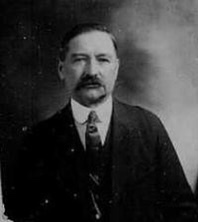
John Bernard Molitor J.B. appeared to have been a man on the move along with some of his siblings. He married Jennie Klotz (more on the Klotz sisters in upcoming posts) in 1892 in Chicago, and in 1900 was located in Ward 27 of Chicago (near present day Logan Square) as a carpenter with three kids, a sister (Lizzie Duschere), a niece (Martha Duschere, 2) and a brother (Nick, 35). Lizzie would later move to La Cross, WI and by 1920 locate in Detroit MI with her husband Ernest and her daughter.
Between 1892 and 1900, J. B. had one child (Robert John) born in 1893 in Chicago, one child (Eva Marie) born in 1895 in Hilbert, Calumet County, WI (east of Lake Winnebago, near of Appleton, WI), and another son (Albert James) born in 1898 in Chicago, IL. In 1899, his sister, Barbara, dies at age 44 in Aurora, Kane County, IL.
Still on the move, in 1901, J.B. Has another son, Joseph P. L, born in Plainville, Adams County WI (just north of the Wisconsin Dells). In 1903, he has a son James P. in Chilton, Calumet County, WI (due east of Lake Oshkosh). 1906 he has another son, Alex P. In Hilbert, Calumet County, WI (just 7 miles due north of Chilton). He has another son born in 1909 and in the 1910 census was listed in Chilton, Clement County, WI with Jennie, his children and brother, Nicholas, as owning and working a farm. By 1912, he appears to be back in Chicago, unfortunately with a death of a young son James P. By the time of the formation of the Vegetable Growers Supply Co., he is owning and operating a greenhouse in Rogers Park.
The older Molitor brothers (J. B.’s uncles and father), Mathias (born 1804, arrives 1852), Peter (J. B.’s father, born 1807, arrives 1849), Theodore (born 1810, arrives 1858), and Nicholas (born, 1814, arrives between January 1849 and 1854), all get settled in Wisconsin in the 1850s and their children become farmers and involved in the lumber industry. More significantly, Taylor County, Wisconsin, is right in the middle of the region where the new Vegetable Grower’s Supply Company was looking at sourcing lumber from nearby lumber mills.
J.B.’s extended family immigration well before the big wave of Luxembourg immigrants in the 1880s, his own back and forth between Chicago and different parts of Wisconsin, his knowledge of carpentry as well as his and his family’s knowledge of the Wisconsin lumber industry, likely proved instrumental for quickly sourcing lumber for lettuce and vegetable boxes in Chicago.
But what drew J. B. away from Wisconsin to come to Chicago as a carpenter? Quite possibly he had an older cousin, John (brother of the Taylor, County Bernard Molitor and son of the first Molitor in Sheboygan Mathias) who lived in Chicago between 1870 and his death in 1911 and worked as a carpenter. Did J. B. feel the need to seek opportunity in the rapidly growing city of Chicago and follow in his older cousin’s footsteps? Did his relationship with his sister, Barbara, who settled into a farm in Aurora, Kane County, Illinois, encourage him to seek opportunity in Chicago?
Regardless of his motivations, two facts stand out. First, his extended family’s settlement in Wisconsin gave him good connections to lumber mills in Wisconsin. Second, like many Luxembourg immigrants, he gets drawn to the burgeoning financial opportunities in greenhouse truck farming in Rogers Park and Chicago. Whereas fellow founder J. P. Smith brought deep Rogers Park connections and access to banking and construction, J.B. Molitor provided the Luxembourg greenhouse growers with access to lumber and knowledge of carpentry. The formation of Vegetable Growers Supply Co. was made possible by the fortuitous and productive family connections between the first wave of Luxembourg immigrants in the 1840s and 1850s.
As we will see in future posts, we will see many examples of this intertwining of family relationships.
-
J. P. Smith: Man at the helm
Standing 130+ years away from the largest wave of Luxembourg immigration into Chicago and the United States, it is easy to repeat the often repeated oral tradition that our ancestors came from Luxembourg in the 1880s and 1890s and started as day laborers and truck farmers who then built greenhouses to grow year-round.
What this leaves out is how did they do this? What social and financial networks did they rely on when arriving? What are the familial relationships underpinning this group of immigrants? What means did they come with? How did they become successful? Questions abound.
My next several posts will be focusing on the five original “men in the middle” of the Vegetable Growers Supply Co., centered in Rogers Park,. IL: J.P. Smith, Joseph Rengel, J.B. Molitor, Michael Leider, and Robert F. Dilger. Each of these men, were in their primes at the founding. (John Phillip) J.P. Smith was 53 years old at the founding of the new company, being born in 1865. (John) Joseph Rengel was 47, born 1871. (John Bernard) J. B. Molitor was 51, born in 1867. Robert F. Dilger was 59, born in 1859. The young man in the group, Michael Leider, was 42, born in 1876.
And all but Michael Leider were not immigrants. They were born in the U.S. J. P. Smith, Joseph Rengel, and Robert F. Dilger were born in Chicago, Cook County, IL and J. B. Molitor was born in Sheboygan, WI. Only Michael Leider was born in Luxembourg (Deikirch). This point is critical, as these men and their families had already established a presence and an economic presence four decades before the bigger group of immigrants arrives and six decades before the founding of the new company. The earlier immigrants greatly helped those who followed.
The new company’s president, J. P. Smith was the son of a German immigrant, Peter Schmidt Jr., born in 1824 in the Rhineland Palatinate region immediately east of Luxembourg and west of Frankfort Germany, who came to the U.S. in 1840 at age 16, with his father, Peter Schmidt Sr., 52 at the time, and settled north of the city of Chicago. The 1850 census rolls for Ridgeville (now part of Evanston) and in the 1870 Evanston census. Peter Schmit Sr. (his German name, spelled incorrectly by an immigration clerk as Schmidt), is recorded as entering the U.S. with $6,000 French francs, today worth about $375,000 today, indicated he had financial means in Germany before coming to the U.S.
Peter Schmidt Sr. came over with another German immigrant, Henry Fortmann, and they built log cabins in what’s is now part of Evanston, and started truck farming to serve the growing city. Eventually, their combined lands encompassed 250 acres. In 1851, Henry Fortmann built a small frame house near Devon and Touhy Avenues to offer mass for Luxembourger and German immigrants. In 1852 it was dedicated as the first and later to become, the well-known St. Henry Church.
Peter Sr. went on to become a prominent Ridgeville leader, serving as justice of the peace and was a master bricklayer who recycled bricks from the Chicago Fire to build his dream home at 6836. N. Ridge Boulevard.
His son, Peter Schmidt Jr. married Elizabeth Phillips, also born in Germany (Koblenz), in 1849 in Cook County, IL. Her father, Jacob Phillip emigrated in 1842 and went on to own several tracts of land at Ridge and Touhy as well as a flour and feed store in Ridgeville. Her brother, Jacob’s son, founded Phillips State Bank at 7001 N. Clark Street in 1895. It is this bank that shows up in the articles of incorporation of the Vegetable Growers Supply Co. Peter Schmidt Jr. had a twin brother, Jacob, who emigrated with the family in 1840 but at some point left Chicago, probably after the Great Fire, and who died tragically after an accidental gunshot wound in 1882 in Aspen Colorado.
Peter Schmidt Jr.’s son, our J. P. Smith, married Katherina Evert, born in Rose Hill, Chicago in 1869. Her parents were both Luxembourg (Deikirch) immigrants who arrived around 1851. The1900 census records have J.P. Smith as a farmer and in 1910 as a greenhouse grower, which means this family made the transition to growing under glass, like all the others.

Peter Schmidt., Jr. 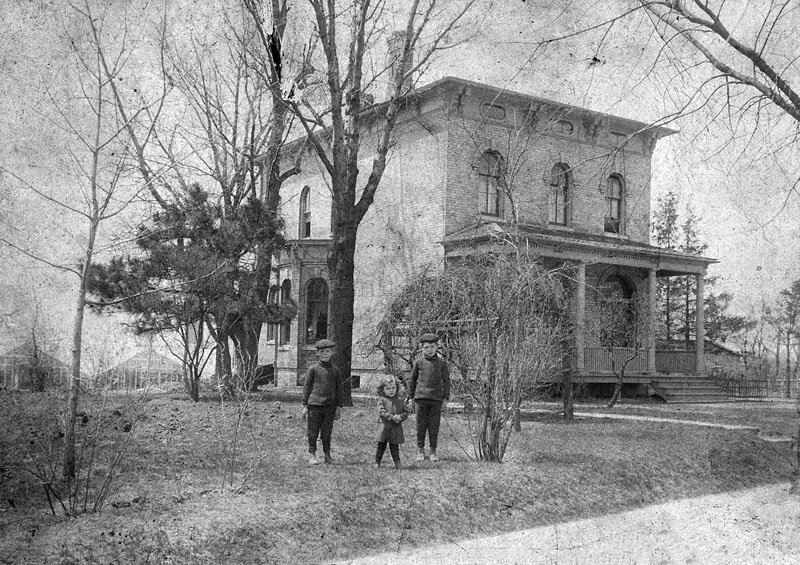
Peter Schmidt Sr.’s “Dream house” built in 1871. Grand total cost for this house was $5,150. This picture is from March 1903. Notice the greenhouses in the back left and carriage shed in the back right.
“Peter Jr. is in the process of building the new Victorian brick house just a few hundred yards north at 6836 Ridge. (still standing today and still in the family) The mason’s have just dug the 100 ft long trench (3ft wide and 2ft deep) so the wagons can dump the lime for mortar-making that will take a year to work before construction begins. The carpenter has quoted and will build for $106.00 (about 6 months work.) The Georgian marble for the fireplace was ordered a year ago but the Civil War has eliminated that source in Georgia and so Michigan veined-white marble will be used instead to create the Paris apartment style fireplace in the front parlor. The 2 Eisenglass stoves, for heating the upstairs and downstairs, will come later. Heating stones on them to place at the foot of your feather-bed will help with the winter nightly cold. … Peter Jr’s sons in later years would climb the big poplar tree in the back of the 1871 – 6836 N Ridge – house to enter their 2nd story bedrooms; thus avoiding their awaiting Father states Louisa Smith, his daughter.” – from davidafortmanancestors.comJ. P. Smith shows up in probate records as the executor of his mother-in-law’s will in 1917 and as an administrator of his father’s estate in 1902, who died without a will. The amount of his father’s estate in probate was approximately $26,000 (approximately $806,000 today), no small sum even for a well-off German immigrant farmer making his way in a part of Illinois just less than a decade after the Blackhawk tribe is cleared from the area. Around the turn of the century, J. P. Smith was the Commissioner of Indian Boundary Park (I remember walking there as a boy when we visited my great-grandfather’s house and greenhouse). J. P. Smith was also quite experienced in greenhouse trade associations. In June of 1913, five years before the new company is formed, J. P. Smith was named a director of the Chicago Greenhouse Vegetable Growers’ Association (along with Robert F. Dilger and J. B. Molitor) and at this meeting, the directors discuss the escalating price of small lettuce boxes.
The Schmidt family was an important, well-off early settler of Ridgeville, associated with the founding of St. Henry Church in Rogers Park and was familiar with farming, woodwork, construction, business and banking. J. P. Smith grows up in this family of strong means and capabilities precisely at the time Chicago is rapidly growing, allowing truck farming and greenhouses to open up many paths to success for new immigrants. America’s cheap access to land and no form of feudalistic practices with its onerous taxation to land barons gave Luxembourg and German immigrants much better economic prospects.
J. P. Smith was well prepared, well-connected, and perhaps, as far as I can surmise, the leading man among all the growers in the region. With his wife’s Luxembourg background, further connections with many Luxembourg immigrants in the 1880s and 1890s became possible. It would be natural, or perhaps inevitable that J. P. Smith would lead this company.
At the helm of the Vegetable Growers Supply Co. at its start was not a Luxembourg immigrant, but a son of well-off German immigrant family with the needed knowledge, skill and economic capability to lead the others. As I dig into the background of the other four leaders in future posts, it will become clearer that the flourishing of Luxembourg greenhouses in the north Chicago area was made possible by a combination of relationships, skills and business savvy of early German and Luxembourg immigrants who settled and became the founding families of these areas beginning in the 1840s. As it turns out, many things are connected.
As I continue to delve into the details of the new company, its founders and the connections between them, it is very likely that I may miss things, make incorrect inferences, start with faulty assumptions and otherwise make errors. For anyone with corrections, oral histories or stories to tell, please do so!
-
Officer elections and orders for wood
Later in the evening after the Vegetable Growers Supply Co. shareholder meeting on January 14, 1919, the directors held a meeting at 7 pm at Arcanum Hall in Rogers Park, Chicago, to elect corporate officers and to discuss orders for wood from the Wisconsin mills.
With the new directors all present, J. P. Smith was again elected President, Joseph Rengel was again elected Vice President, J. B. Molitor was again elected Secretary. Michael Leider was placed in nomination as treasurer but passed, and instead placed Robert F. Dilger in nomination. Mr. Dilger was elected as Treasurer.
The board then instructed Secretary J. B. Molitor to correspond with the three Wisconsin lumber mill operators: Mr. M. Stryk in Lublin, Bellinger Mills in Thorp, and Heib Manufacturing Co. in Merrill. These mills were located north central Wisconsin between the Eau Claire and Wausau, WI.
Molitor was instructed to discuss pricing and discounts and order three rail cars of lettuce box lumber, one from each mill. With no other business, the directors adjourned.
Three days later, on January 17, 1919, the directors met again at Arcanum hall at 8 pm, this time to iron out more corporate governance details. On a motion made by Frank Herff and seconded by Michael Leider, the directors unanimously agreed to establish an executive committee with J. P. Smith, J. B. Molitor and Robert F. Dilger as members.
The directors then agreed to establish commissions for new stock sales and stock transfers to compensate parties for the costs of recording these transactions. In the case of sales of new shares to any party not currently a stockholder, the secretary was to receive a 5% commission. In the case of a current stockholder transferring shares to a new owner, the commission would be split at 2.5% each between the secretary and the party selling the shares.
The directors then established pay for the members of the executive committee or any member, who are called away for company business at $3 ($48) per day or $2 ($32) for a half day.
-
Corporate democracy at work: districts and voters
The articles of incorporation called for annual stockholder meetings on the second Tuesday of each January at 2 PM so, on January 14, 1919 at 3 PM (one hour late!), 55 out of 91 shareholders of the new Vegetable Growers Supply Co. meet at Arcanum Hall 7013 Ravenswood Ave., in Rogers Park, Chicago. This represented a quorum of shares represented (326 out of 500). Being selected as chairman for this annual meeting, J. P. Smith called the meeting to order with J. B. Molitor, who was selected, as secretary.
J. B. Molitor relayed to the shareholders the total for expenses to date related to incorporation and that the directors have rented Mr. John Gretz’ shop at Clark St. and Birchwood Ave. and prepaid him for six months rent. The rent prepayment was $170 ($2,720) and the incorporation and organizing costs were $437.22 ($6,995.52), bring the total for these two expenses to $607.22 ($9,715.52). Original capitalization money raised in November, 2018 was $25,000 ($400,000).
The main item of interest at this shareholder meeting involved the organization and selection of directors based districts where the greenhouse growers reside. The four districts established were:
- Rogers Park
- Niles Center (Skokie today) & Morton Grove
- Gross Point (Western part of Evanston and Wilmette today)
- Evanston

“This is Devon Avenue in 1914 looking east from the east side of Western Avenue in the West Ridge community of Chicago. The people were walking from Angel Guardian’s Church (steeple is barely visible in the background on the far right-hand side, just above the tree line) back to a truck farm on the SW corner of Rockwell and Devon. … In the late 1840s through the 1870s, another group of immigrants arrived from the independent Duchy of Luxembourg, which had been recently dramatically partitioned and faced economic strains from the years of war. Culturally similar, these early families intermarried and shared resources as they built the new community of Ridgeville.” (From Lost Towns of Illinois). The truck farm looks like a greenhouse. The location is the southwest portion of Rogers Park. The directors called for a 10 minute recess where the stockholders could meet together with those in their district and vote for director nominations. The following nominations were put forth:
Rogers Park: J. P. Smith, J. B. Molitor, Anthony Kremer, Frank Herff, Nick Schmidt, Robert F. Dilger, Frank Klein, Anton Stranski, Peter Nepper, Peter Andre.
Gross Point: Matt Hoffmann, Nic Schwind, Joseph Rengel, William Rengel
Niles Center and Morton Grove: Ferdinand Kutz, Nick Platz, H. Ahrens, Henry Modaff
Evanston: Henry Didier, Charles Schwind, Julius Knarkard, Michael Leider
Chairman J. P. Smith appointed J.P Schneider, Nick Kaiser, and Peter Harles as tellers and judges of the election. Voting then commenced and upon ending, the tellers reported the results, numbers based on shares held by stockholders voting:
- Rogers Park District (1,312 shares voted)
- J. B. Molitor, 224
- J. P. Smith, 178
- Frank Herff, 173
- Anthony Kremer, 167
- Robert F. Dilger, 166
- Frank Klein, 153
- Nick Schmidt, 140
- Peter Endre, 46
- Peter Nepper, 39
- Anton Stranski, 26
- Gross Point District (576 shares voted)
- Joseph Rengel, 239
- Matthew Hoffman, 212
- William Rengel, 86
- Nick Schwind, 39
- Niles Center and Gross Point District (614 shares voted)
- Ferdinand Kutz, 242
- Nick Platz, 206
- Henry Modaff, 130
- Henry Ahrens, 36
- Evanston District (606 shares voted)
- Michael Leider, 261
- Henry Didier, 155
- Julius Knackard, 131
- Charles Schwind, 59
Based on these vote totals, the names in bold above were elected as the directors of the Vegetable Growers Supply Co. and the Rogers Park District maintained a large contingent of directors (5 out of the 11), even with establish districts to ensure board representation from districts with fewer vegetable growers in it.
The formation of districts to appoint directors is not called out in the articles of incorporation, and given the absence of discussions in the minutes, this arrangement was likely discussed with many stockholders outside each meeting. Perhaps this is the reason this meeting started late?
-
The search for space and the price of relief
At the January 13, 1919 directors’ meeting of the Vegetable Growers Supply Co., at Arcanum Hall, 7013 Ravenswood Ave. Chicago IL, the directors found themselves a bit behind on approving prior meeting minutes and promptly dispensed with approval of minutes from the past two meetings. President J.P. Smith then turned to two pressing matters: the search for space and the cost of a surety policy.
The space committee members reported that they looked at a number of properties in Niles Center and Morton Grove, but did not find anything satisfactory. They asked for more time to search for a space or property. The committee also said they agreed to rent the shop from Mr. Gretz at Clark and Birchwood Avenues, Chicago, IL. for $300 ($4,800) per year, for one year. The Board agreed and Mr. Gretz was present to sign the lease.
Mr. Gretz also offered the use of the gasoline tank on the lot and perhaps more importantly, the use of the water closet in his flat in the building on Clark Street by the men working at the new company’s shop. Not offering a price himself, Mr. Gretz let the company name the price for these privileges.
President Smith offered Mr. Gretz $40 ($640) for one year for these two privileges and Mr. Gretz agreed. The board quickly followed with its assent. Perhaps and just guessing, given the hour of the evening (the meeting started at 8 pm and likely was preceded with favorite beverages) I supposed this was an offer the new company and Mr. Gretz could not refuse. It was probably wise that the Mr. Gretz let the board name the price for bladder relief rather than the reverse. Or perhaps he wanted the board to feel generous. Negotiating 301.
The directors then turned their attention to the surety policy (a form of insurance policy on the company’s ability to deliver upon its planned activities). The directors read the proposed policy and found it unsatisfactorily drawn up. The directors than moved to seek out an attorney for assistance regarding the policy and adjourned for the evening.

Clark Street at Lunt Ave., Rogers Park, Chicago, IL about 1911. -
One demand rejected, two offers extended…
The directors of the brand new Vegetable Growers Supply Co. met at 8 PM on January 7, 1919, again at Arcanum Hall, 7013 Ravenswood, Chicago IL, just week and one day after their last meeting. The purpose of this meeting was to deliberate further on two pressing items: from whom to get lumber and what location to rent or buy to set up operations.
The last meeting’s long discussion on renting Wm. Becker shop floor space on Clark Ave. probably had a reason for it being long. J. P. Smith, Micheal Leider and Anthony Kremer reported that Wm. Becker would rent his space to the new company, but only if it met one condition: that they sign a contract to purchase box lumber from him for two years.
Standing more than 100 years after this meeting, I have to surmise that the directors probably knew of Wm. Becker’s intentions and that the directors wished to meet with him to determine if he would be friend or foe to their new company. Given that the whole purpose of the new company was to make boxes for the vegetable growers at lower costs, it didn’t take the directors to make their decision.
A motion (was) made and duly seconded to reject the offer of Wm. Becker and quit trying to make a deal with him.
Bam!
The directors asked the space committee to look at “certain properties” in Niles Center (present day Skokie) and Morton Grove which may be offered for rent or for sale. They also directed the space committee to see a Mr. J. Gretz to rent his shop on Birchwood Avenue and Clark Street in Rogers Park, Gretz’ space was presumably to be used on a short-term basis until a proper space can be identified. Nick Schmidt replaced Anthony Kremer on this space committee.
Before ending the meeting, the directors authorized the secretary to order two cars of lettuce box lumber, one from Bellinger Manufacturing Co., WI and one from Mr. Stryk, Sublin WI, and to invite both of these parties to the next directors’ meeting on January 13, 1919.
It looks apparent that the directors of the new company were anticipating uncertainties and developing options accordingly.

Chicago vegetable growers, probably 1920s or earlier. From wbez.org

 Chicago Greenhouse Growers